WORKFLOW
Run controls appear before graph inspection. Workflow status and outputs, Graph preview, and New stage start collapsed. The current stage inspector remains visible, and collapsing the other sections preserves their controls and state.
Run logs starts collapsed before the stage editors. Expand it to follow execution. Startup warnings stay visible, and Python errors mark their stage as failed.
Page snapshot
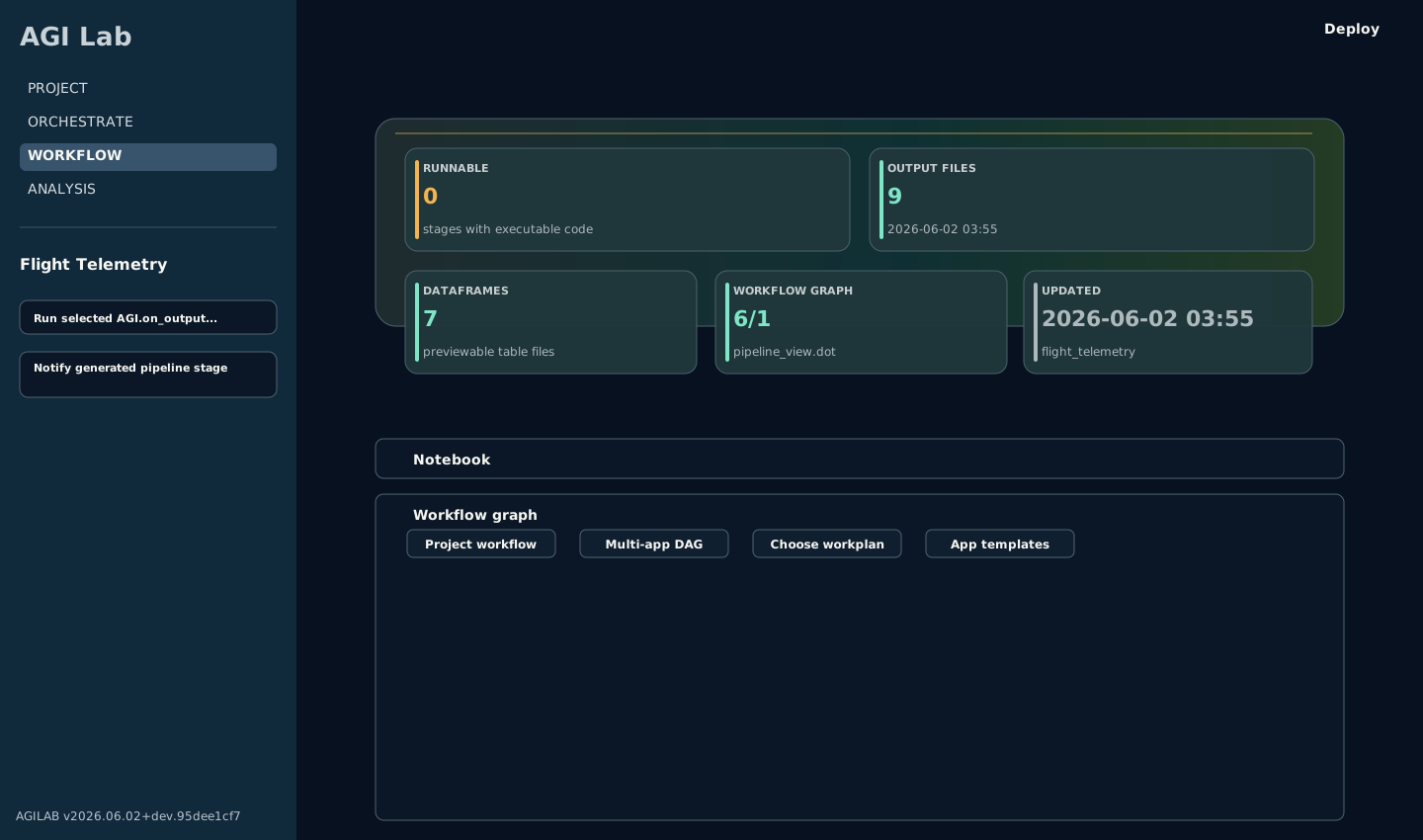
WORKFLOW keeps notebook and pipeline controls in the workspace. Open Tools in the header to reach DataFrame selection and MLflow.
Workspace and workflow controls
Choose the active project with the React header’s Project selector.
WORKFLOW resolves that project’s lab directory under AGILAB_EXPORT_ABS
and loads its stage definitions and available dataframes.
Open Tools in the header to choose a DataFrame or reach MLflow. This contextual panel starts closed on desktop and mobile. Hiding and reopening it preserves editor drafts and form entries; project selection and the main workspace navigation stay in the header. Standalone Python pages use a Tools button to open the same panel.
The stage definition lives in the project’s
lab_stages.toml. The retained Python-backed pipeline editor controls its stages; the collapsed Stages file summary exposes the resolved file when you need to inspect context.DataFrame selects an available input file for the assistant. Its resolved path stays under the project’s export root.
When the local tracking UI has been started, the MLflow link and status let you open that tracker. The tracker shows execution evidence.
Main Content Area
ASSISTANT
Each lab is organised as a sequence of stages stored in lab_stages.toml.
The numbered buttons at the top let you jump between them. Ask questions or
describe transformations in the text area—AGILab forwards the prompt to the
Responses API together with the selected DataFrame metadata. The code editor
reacts to the toolbar actions:
Savekeeps the snippet as-is in the current stage.Nextpersists the snippet and advances to a fresh stage.Removedeletes the stage fromlab_stages.toml.Runwrites the snippet tolab_snippet.py, executes it and stores any produced dataframe underlab_out.csvso the preview and the Orchestrate/Analysis pages can consume the result.
The runtime is chosen from the Execution environment box below the editor.
If you pick a concrete virtual environment path the snippet runs via
run_agi inside that environment (the path is kept with the stage under
the E field). Leaving the selector on the default AGILab environment
falls back to run_lab, reusing the managed runtime that ships with the
app. In both cases the exported dataframe and history behave identically.
The assistant automatically reloads the most recent dataframe and shows it below the editor. If nothing has been saved yet, you will see a reminder to run a snippet first.
When your lab step is based on app execution, use the WORKFLOW add flow:
Generate the target snippet in ORCHESTRATE (typically
AGI.run).In Add stage (or New stage on an empty project), choose
Stage source =Generate stageto regenerate from prompt, or select an existing exported snippet to import it directly.The default generation mode is Safe actions. The assistant returns a versioned JSON action contract, AGILAB validates it against the loaded dataframe schema, and the page saves deterministic pandas code derived from that contract.
Use Python snippet (advanced) only when the transformation cannot be represented by the safe action registry and you intend to review the raw generated code yourself.
Imported snippets are marked read-only and run with the project manager runtime.
If you change values in Orchestrate arguments, regenerate or re-import the snippet in WORKFLOW before running the stage.
AGILab does not silently rewrite saved Python snippets when a lab is reopened. If a generated stage becomes stale after an app or orchestration change, the saved code remains unchanged until you explicitly regenerate or replace it. This avoids hidden behaviour changes, but it also means stale generated stages must be refreshed deliberately. For example, if an app renames a runtime argument, older saved snippets that still pass the removed name must be regenerated or replaced before they can run.
Pipeline profiles and stage dependencies
lab_stages.toml can remain a plain ordered stage list, but projects that
need faster replay can opt into explicit single-project workflow automation.
The contract is additive: older stage files without dependency fields still run
in their saved sequence.
The WORKFLOW execution controls expose:
Pipeline profile: chooses the generic automation profile for this run. Built-in profile names arebalanced,smoke,fast,evidence, andcustom. A stage may declare optionalprofiles.<name>overrides; if it does not, AGILAB runs the saved stage exactly as written.Parallel stage workers: caps how many independentagi.*stages can run at the same time. In-processrunpystages remain serialized because they share the Python view session state.Save automation settings: persists the selected profile and worker cap in thelab_stages.tomlmetadata. Opening WORKFLOW or changing the controls does not rewrite the file until you press this button.Stage dependencies: lets you review or editdepsfor the selected stages.Suggest dependenciesderives candidate edges from install/pipeline naming and explicit path literals such asdata_inanddata_out. Review the suggestions before pressingSave dependencies.Selected execution plan: shows the selected stages in their execution waves. Solid edges represent declared dependencies; dashednextedges show the selected order when no dependencies are declared. The separateSaved stages overviewdescribes all saved stages, regardless of the execution selection.
Clearing the stage selection keeps it empty across reruns and reloads. Select at least one stage before running; an empty selection never means “run all”.
A dependency-aware stage entry uses stable ids instead of fragile list indices:
[[my_project]]
id = "prepare_data"
deps = []
D = "my_app/pipeline"
R = "agi.run"
C = "..."

[[my_project]]
id = "train_model"
deps = ["prepare_data"]
D = "my_model/pipeline"
R = "agi.run"
C = "..."
The runner validates the graph before execution. Duplicate ids, unknown
dependencies, cycles, or dependencies outside the selected execution sequence
block the run instead of producing a partial or racy pipeline. When dependencies
are valid, AGILAB computes topological waves: independent agi.* stages in
the same wave may run concurrently, while dependent stages wait for their
upstream wave.
Stages can also declare an optional output-existence skip rule inside the same stage entry:
[[my_project]]
id = "prepare_data"
deps = []
D = "my_app/pipeline"
R = "agi.run"
C = "..."
automation = { skip_if_outputs_exist = true, outputs = ["my_app/pipeline"] }
This rule skips a stage only when every declared output exists. It is a
convenience for fast local iteration, not a full freshness proof: AGILAB does
not compare input mtimes, dependency hashes, or semantic content for this
shortcut. Use reset_target or clear outputs when you need a clean rebuild.
Each workflow run writes a local automation manifest beside the run logs. The
current schema is agilab.pipeline.automation.v2. The manifest also records
agilab.pipeline.automation.v1 as a compatible schema for readers that only
need the original profile, wave, stage status, and dependency fields. The
manifest records the selected profile, worker cap, stage ids, dependencies,
computed waves, per-stage status, declared output records, and a DOT dependency
graph. Output records include resolved paths, existence, file or directory
classification, size and mtime when available, and a SHA-256 for regular files
up to the bounded manifest hashing limit. Larger files and directories are
classified instead of hashed so workflow logging stays cheap. When MLflow
tracking is available, the parent run also stores the automation metadata and
dependency graph as text artifacts. The pipeline_metadata/automation.json
artifact records schema, compatible reader schemas, producer, producer version,
local-only scope, workflow source, app, target, profile, run id, max workers,
dependency waves, stage ids, and stage dependencies. For parallel waves, the
automation manifest is the per-stage evidence source; nested MLflow stage runs
remain a serial-stage evidence path. The Latest automation run expander
summarizes the same manifest with a Schema KPI for reader compatibility
status (current, compatible legacy, unknown, or unsupported),
the detailed schema caption, compatible reader schemas, producer, producer version, run id, automation profile, max workers,
local-only scope, workflow source, app, target, lab directory, stages file,
stages file SHA-256, start timestamp, finish timestamp, run duration, run
error, stage counts, wave count, run_manifest_path for the immutable
per-run manifest, manifest_path as the compatibility alias for that same
per-run file, latest_manifest_path for the rolling latest-manifest alias,
manifest SHA-256, declared output count, existing output count, hashed output
count, and oversized-output count. Use
Show output evidence in that expander to inspect the manifest rows for each
declared output: stage, status, specification, resolved path, existence, file
kind, size, hash status, and SHA-256 when available.
The MLflow parent run also records
pipeline_metadata/sequence.jsonwith schemaagilab.pipeline.sequence.v2. That artifact keeps the selected sequence for legacy readers and adds the effective automation profile, run id, max worker setting, dependency waves, stage ids, and stage dependencies so the tracker evidence matches the actual waved execution plan.
Workflow graph scopes
The Workflow graph expander is the transition path from a single-project
workflow to cross-app artifact orchestration. Use the Workflow scope
selector to choose what the graph represents:
Project workflowrenders the currentlab_stages.tomlas a read-only compatibility graph. It explains stage order and dependencies, while the existing stage controls remain the source of truth for real single-project execution.Multi-app DAGloads or edits a cross-app artifact contract. This is the path for connecting app stages through explicit produced and consumed artifacts.
For Multi-app DAG scope, use the Workplan source selector to choose
where the plan comes from:
App templatesloads checked-in workflow templates bundled with the active app.Sample libraryloads checked-in public examples fromdocs/source/data/multi_app_dag*.json.Workspace draftsloads plans saved from the current project workspace under.agilab/multi_app_dags.Custom pathloads an external JSON plan by path.
The graph is visible immediately below a compact readiness summary. Select
Inspect stage to highlight a stage and inspect its inputs, outputs, app and
executor. Labels use separate lines for the short identifier and status; full
identifiers remain available in the inspector.
Inspecting a stage changes the details shown. The run buttons follow workflow
readiness: Next run names the stage that will be attempted, while Batch run
lists the batch targets. These may include a waiting stage whose inputs have
become available since the last state update. Next preview identifies the
stage affected by the preview action. Changing the inspected stage does not
change these execution targets.
For a waiting stage, Waiting for inputs identifies each missing output and
its producer’s state. The guidance distinguishes a producer that is ready,
running, waiting, failed, or done without the expected output. Inspect producer
opens that stage in the same inspector. Inputs already recorded as available
are excluded from the missing-input list. Unknown producers are reported so
the dependency can be corrected.
Stage labels use ready, waiting, running, done, failed and
stale consistently across the graph, inspector and displayed history.
Plans with more than eight stages initially show Selected stage and neighbors:
the selected stage and up to three connected stages. Neighbor group browses
the remaining neighbors in plan order. This view draws connections between stages;
the inspector lists their inputs and outputs. Choosing another stage returns to
its first neighbor group. Use the searchable stage selector to reach any stage,
or choose Whole plan for the complete graph with artifact nodes.
Open Stage trace and outputs to inspect events and output records for the
selected stage. The trace shows the latest twenty events and offers a CSV download
of its full recorded history with common secret values redacted. Outputs distinguish
planned paths from records attributed to this stage and show recorded locations,
timestamps and hashes when present. These are runner-state records; this view does
not read output files or verify their hashes. Missing records remain explicit.
Stage details contains the executor, complete long input/output lists and full
DOT download. Plan details contains source paths, logs, evidence, handoff tables
and execution history for the plan.
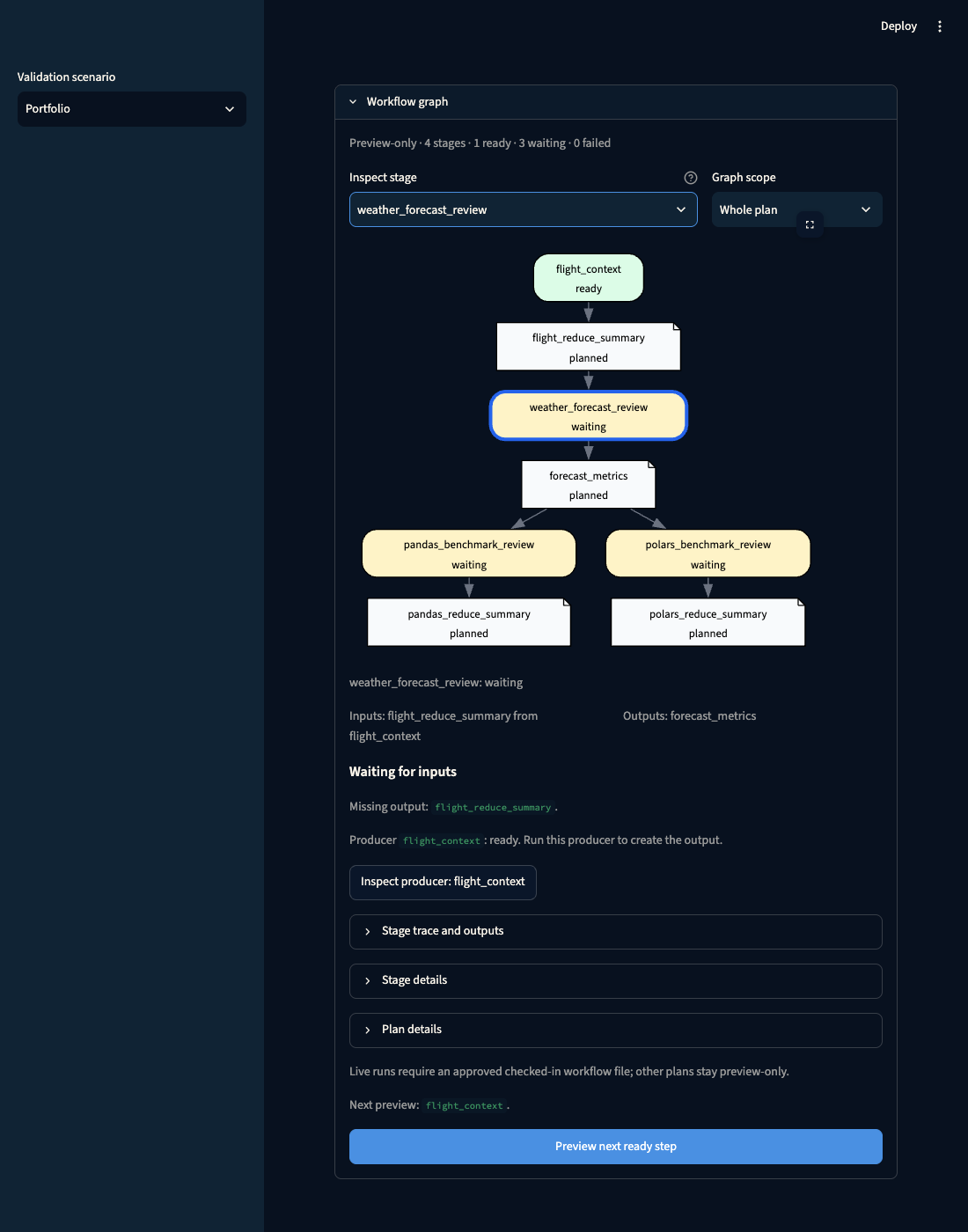
Four synthetic stages modeled on the shipped portfolio sample explain why the inspected forecast stage is waiting and link to its input producer. This documentation capture uses the WORKFLOW graph component in a preview fixture with real execution disabled.
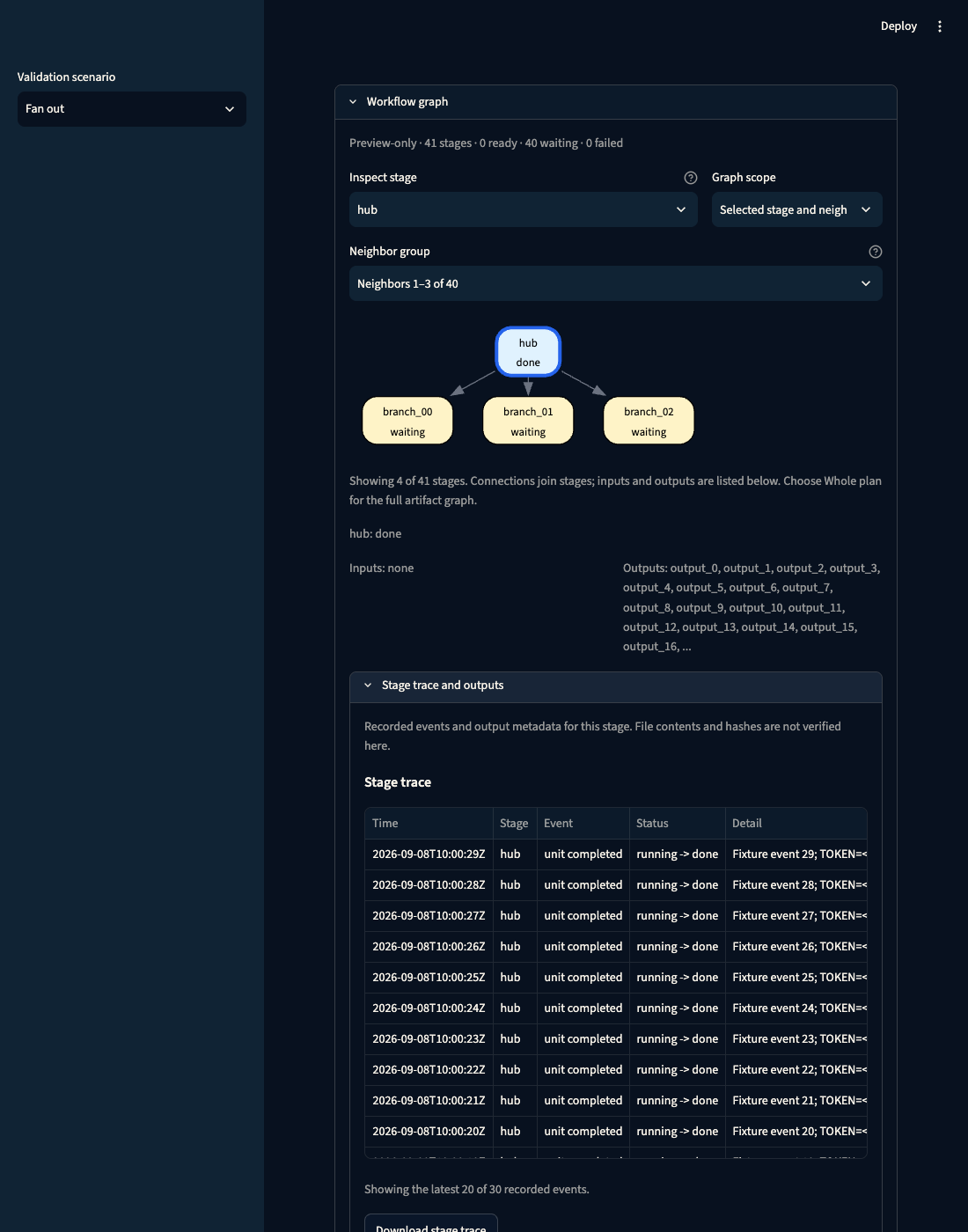
A synthetic forty-branch preview demonstrates bounded graph navigation and stage-specific trace inspection. Its synthetic events and planned outputs illustrate the inspector; they are not evidence of a real application run.
To edit a plan, enable Edit plan. The normal editing path stays away from
raw JSON:
Stepschooses the app-level steps in the plan.Createschooses the outputs produced by those steps.Useschooses which later steps use earlier outputs.Check planvalidates the schema, app names, inputs, and outputs.Save as workspace planstores the draft for the current project.Show generated JSONis available for review or export, but it is not the primary editing flow.
Execution is intentionally conservative:
Preview next ready stepis a preview action. It updates the persisted runner state without claiming that an app really ran.Run next stageis only available for checked-in workflow templates with a controlled execution marker. AGILAB ships controlled examples, and app-owned executable templates saved under an app’sdag_templatesdirectory can use the generic controlled contract adapter.Run ready stagesexecutes every currently runnable controlled stage in one batch. Independent branches can run concurrently, and each stage still owns its app runtime, including any AGI/Dask distribution used inside that app.When a distributed stage submitter is configured, a
Stage backendselector appears before the run buttons.Local contractskeeps execution in the current UI process;Distributed backendsubmits each ready stage through the configured backend and recordsdistributed_stageprovenance in the DAG state.Run next stageis local only and is disabled whenDistributed backendis selected. UseRun ready stagesto submit work through that backend. WhenDistributed backendis selected, WORKFLOW shows the exact per-stage request preview before the run buttons: app, scheduler, worker nodes/slots, workers data path, mode integer, apps path, and the JSONRunRequestpayload that will be sent for each stage. The built-in submitter is configured from the active app’s saved ORCHESTRATE cluster settings:cluster_enabledmust be true, a scheduler, workers, andWorkflow share rootmust be present, and each DAG stageappmust resolve undersrc/agilab/apps/builtinorsrc/agilab/apps. Each submitted stage runs in an isolated AGILAB subprocess so parallel ready stages do not share the in-processAGIclass state.Workspace drafts and custom DAGs remain preview-only until they are promoted into a checked-in worker app template with an explicit controlled execution contract. Workerless app templates are still valid AGILAB apps, but they do not imply distributed DAG execution.
The technical JSON contract still uses stable field names so plans remain portable:
nodes[].execution.entrypointnames the stable stage executor, for exampleflight_telemetry_project.flight_context. WORKFLOW displays this value in the stage table and graph so users can see what will execute before pressingRun next stage.nodes[].execution.commandis an optional command-list executor for deterministic local steps. Prefer a JSON list such as["python", "-m", "package.module"]over a shell string.nodes[].execution.params,steps,data_in,data_out, andreset_targetare preserved from the DAG template into the execution plan, runner state, distributed request preview, and distributed submission evidence. This keeps cross-app DAG execution auditable instead of relying on hidden defaults.producesandconsumesdeclare the artifact contract between stages. Distributed executable app templates must declare at least one produced artifact per controlled stage so the runner can publish evidence and unlock downstream stages.
Use the smoke validator before a live two-node run:
uv --preview-features extra-build-dependencies run python tools/dag_distributed_stage_smoke.py \
  --scheduler <scheduler-host>:8786 \
  --workers '{"<scheduler-host>": 1, "<worker-host>": 1}' \
  --workers-data-path clustershare/agi \
  --compact
Add --execute only after SSH, SSHFS, app installs, and ORCHESTRATE cluster
settings are known good. Without --execute, the command writes a dry-run
evidence JSON under test-results/ and does not start Dask workers.
The panel shows the current readiness metrics, graph, artifact handoffs, and execution history. Use the history table to distinguish preview dispatch events from controlled real stage completions before promoting a DAG into a broader orchestration flow.
Notebook import and export
The closed-by-default Notebook expander keeps notebook import and export
near the pipeline definition instead of in the sidebar:
Import notebookuploads an.ipynbfile and previews the stages that would be merged intolab_stages.toml.After preview, keep
All runnable cellsto import the full runnable notebook, or choose one cell as the import scope and promote that cell into an AGILAB stage. Focused promotion keeps the selected cell’s detected artifact contract and environment hints without importing unrelated exploratory cells.Download pipeline notebookexports the current lab aslab_stages.ipynb.
WORKFLOW can export the current lab as a runnable supervisor notebook. This is not just a static dump of code cells. Its purpose is to avoid lock-in: if you later decide AGILAB is no longer needed for a project, the workflow you built is still available as a normal notebook that can be opened, reviewed, adapted, and executed in Jupyter-compatible tools. In short, you do not lose the work because you stop using the AGILAB UI.
The notebook is written beside
lab_stages.tomlaslab_stages.ipynb.You can open it outside the AGILAB UI in Jupyter-compatible tools such as JupyterLab or PyCharm.
For a project-owned notebook layout, keep the same supervisor notebook at
<app-project>/notebooks/lab_stages.ipynbso it travels with the app:APP_PROJECT="${APP_PROJECT:-/path/to/<app-project>}" uv --project "$APP_PROJECT" run --with jupyterlab jupyter lab notebooks/lab_stages.ipynb uv --project "$APP_PROJECT" run --with nbconvert python -m jupyter nbconvert --to notebook --execute --inplace notebooks/lab_stages.ipynb
For a source checkout, prefer the mirror under
exported_notebooks/<module>/lab_stages.ipynband launch it from the AGILAB root project explicitly, for example:CHECKOUT="${AGILAB_CHECKOUT:-/path/to/checkout}" uv --project "$CHECKOUT" run --with jupyterlab jupyter lab exported_notebooks/<module>/lab_stages.ipynb
or execute it headlessly with:
CHECKOUT="${AGILAB_CHECKOUT:-/path/to/checkout}"
uv --project "$CHECKOUT" run --with nbconvert python -m jupyter nbconvert --to notebook --execute --inplace exported_notebooks/<module>/lab_stages.ipynb
The exported notebook keeps the recorded per-stage runtime and environment metadata instead of flattening the whole pipeline into one implicit kernel contract.
Use the generated helper functions such as
run_agilab_stage(i)andrun_agilab_pipeline()to execute the saved stages in their recorded runtime.When the active app declares related analysis pages, the notebook also includes launcher helpers for those pages.
This is the accurate mental model: AGILAB can export a runnable version of your pipeline outside the UI, but for mixed-runtime or multi-venv flows it does so as a supervisor notebook rather than pretending every stage belongs to one notebook kernel.
Use notebook export when you want a durable exit path, an audit/review artifact,
or a handoff to a team that prefers notebooks. Use project export/import when
you want to move an AGILAB project snapshot between AGILAB workspaces. Use
packaged agi-app-* or agi-page-* artifacts when you want long-term app or
dashboard distribution.
MLflow tracking
WORKFLOW execution and MLflow tracking now share the same runtime contract:
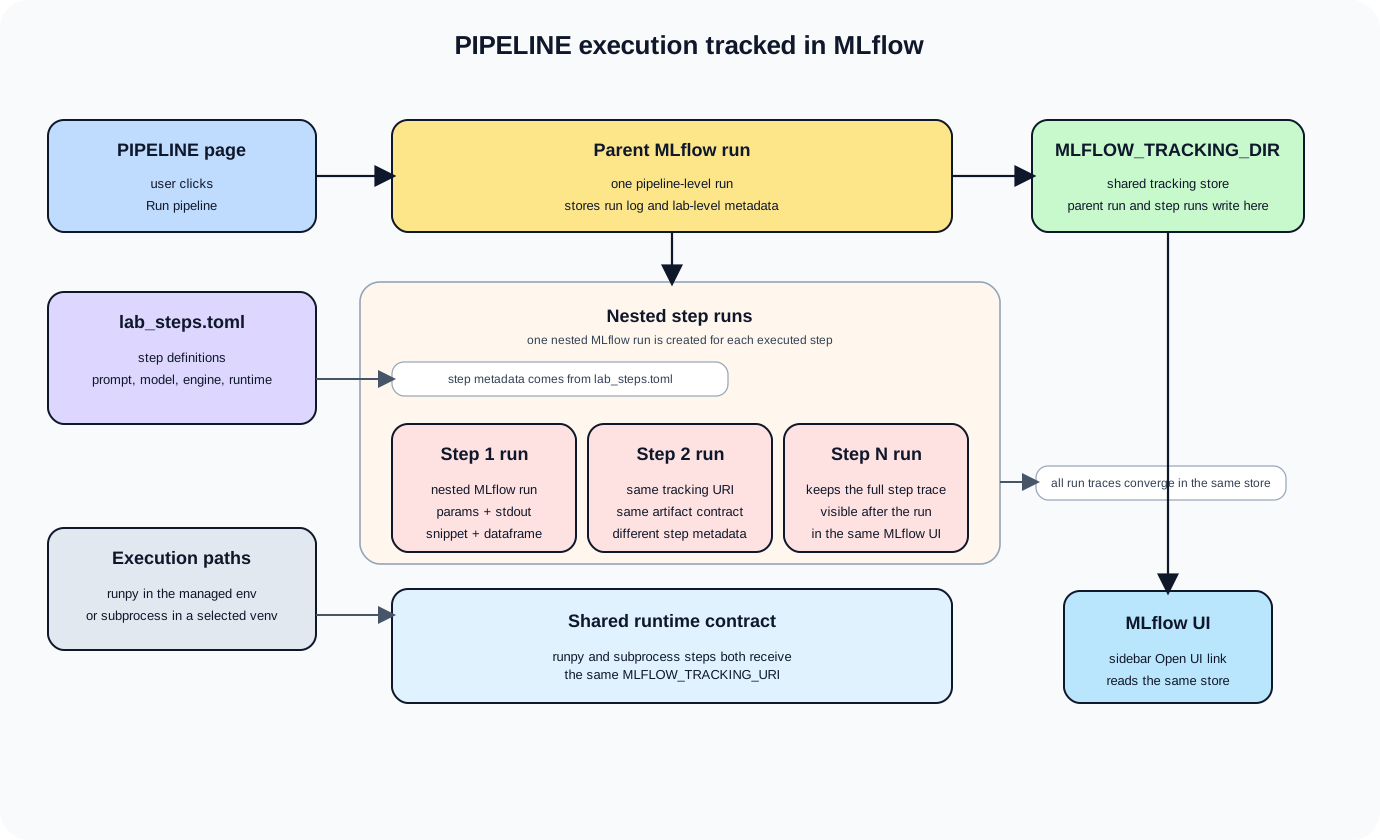
WORKFLOW creates one parent MLflow run per execution. Serial stages create nested MLflow runs, while parallel waves record per-stage status in the automation manifest and attach workflow-level metadata to the parent run.
Run pipelinecreates one parent MLflow run for the whole lab execution.Serial executed stages become nested MLflow runs with their own metadata.
Parallel ready waves intentionally use the automation manifest for per-stage status, stdout, failure, and dependency evidence.
The tracked metadata comes from
lab_stages.tomland includes the stage description, prompt/question, selected model, execution engine, and runtime.Captured stdout, the executed snippet, the run log, and produced dataframe artefacts are logged to the same tracking store when they exist.
This means MLflow is no longer just a nearby dashboard. It is the execution trace for WORKFLOW runs. Use the MLflow link in the workflow controls to inspect that trace.
AGILAB does not define a separate experiment tracker, model registry, run
format, or metrics schema. The AGILAB runtime talks through a small tracker
facade (for example tracker.log_metric(...) and
tracker.log_artifact(...)), and the default backend is MLflow. This keeps
tracking automatic during normal AGILAB execution while preserving compatibility
with existing MLflow tooling.
Inside a snippet or worker, prefer the AGILAB facade when you need custom domain metrics:
from agilab.tracking import tracker

tracker.log_metric("accuracy", 0.94)
tracker.log_artifact("reports/confusion_matrix.png")
The tracking store is the directory configured by MLFLOW_TRACKING_DIR.
Serial subprocess-based stages receive the same MLFLOW_TRACKING_URI as
in-process stages, so both serial execution paths are visible from the same
MLflow UI. For parallel stage waves, use the latest automation manifest in
WORKFLOW as the detailed per-stage execution view.
HISTORY
Inspect or tweak the raw lab_stages.toml via the code editor. Saving the
file here immediately refreshes the assistant tab.
Troubleshooting and checks
Use these checks if Workflow stages are confusing or fail to execute:
If numbered stage buttons do not match
lab_stages.toml, open HISTORY and confirm the selected file is the current module’s lab file.If execution fails on a stale path, regenerate or re-import the snippet in WORKFLOW before rerunning the stage.
If
Runwrites no dataframe, check the destination under${AGILAB_EXPORT_ABS}/<module>/lab_out.csvand ensureWrite permissionsare enabled for the selected execution environment.If an imported notebook is not loaded, re-upload
.ipynband then reopen the stage editor to force a refresh.If MLflow stays empty after a run, confirm that the stage completed and that the tracking store under
MLFLOW_TRACKING_DIRis writable.If MLflow link fails to open, verify
activate_mlflowcompleted and port forwarding is not blocked locally.
See also
Main Page for the overall page sequence.
Distributed Workers for the full distributed workflow from ORCHESTRATE configuration to imported WORKFLOW stage.
ORCHESTRATE for generating reliable snippets before running a stage.
Page bundles for analysis-side visualisations after a successful run.
Versioned pipeline stage templates for the proposed structured successor to raw generated snippets in
lab_stages.toml.