ANALYSIS
Introduction
The Analysis page is the catalog and launcher for installed analysis views and project notebooks.
It lets you choose which AGI pages and notebooks belong to the active project and launch them from one place.
Choose the right surface
Use an AGI page when the analysis is becoming part of the application
contract: a repeatable dashboard, review screen, demo, validation evidence, or
shared result surface. A page reads exported artifacts from the project and the
selected page links are persisted in the project workspace settings under
[pages].view_module. This is the route that enables non-notebook users,
stable demos, CI-backed artifact contracts, and reusable agi-page-*
packaging. The consequence is that you must maintain a page bundle, declared
dependencies, and stable exported artifacts for the page to read.
Use a notebook or AGI snippet when the analysis is still code-centric: exploration, debugging, cell-by-cell reruns, migration from an existing notebook, reusable snippets, or handoff to a technical user. In ANALYSIS, a selected notebook opens through a project-rooted JupyterLab sidecar. Outside the page, exported notebooks and AGI snippets can also be reused wherever the AGI runtime and dependencies are available. The consequence is that reuse depends on the snippet/notebook contract, runtime environment, and declared dependencies; it is excellent for evolving logic but less direct for end users than an AGI page.
Use both when needed: keep an AGI page as the stable result surface and link a notebook or AGI snippets as the investigation trail behind that result. AGI page selections and notebook selections are stored separately.
Page snapshot
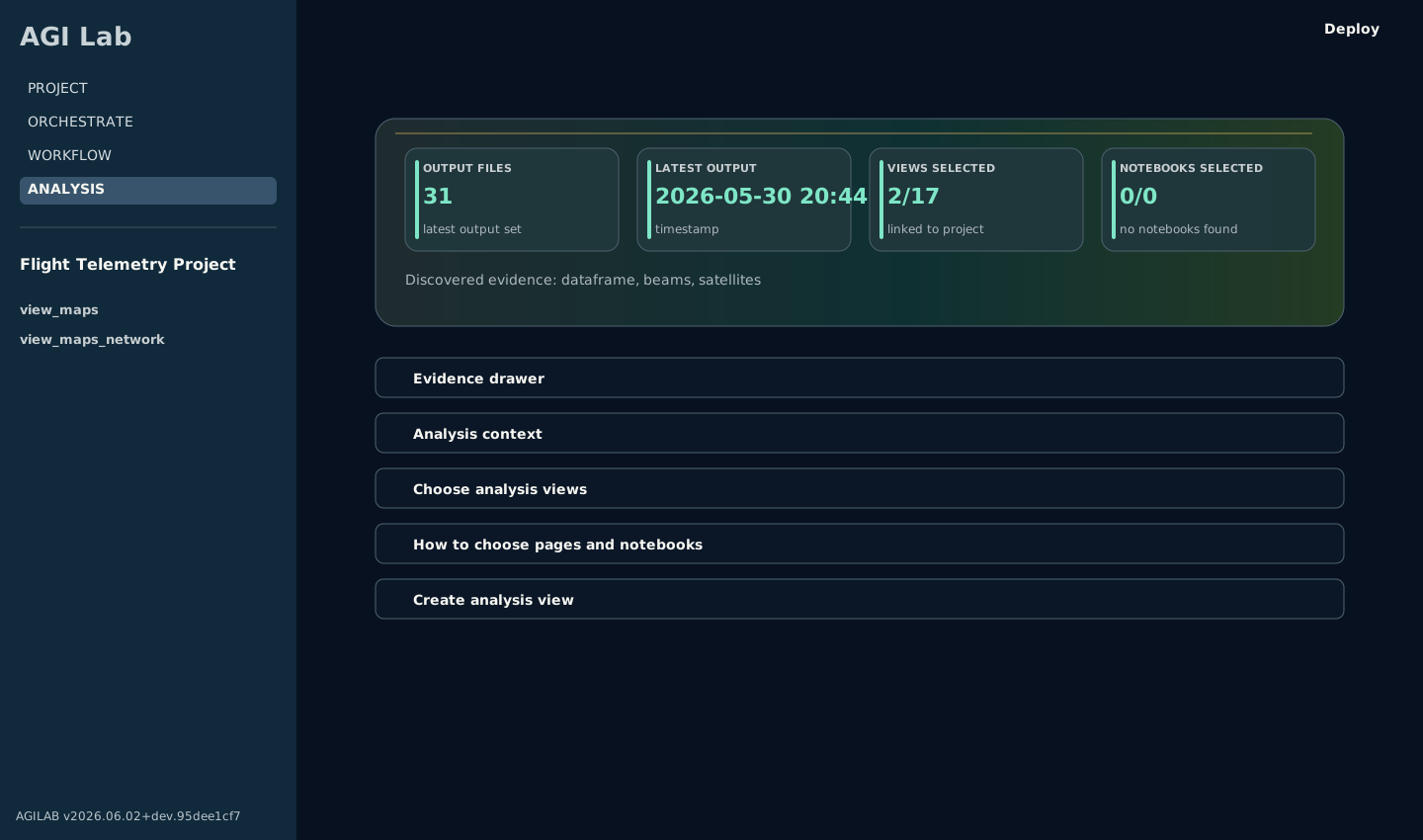
ANALYSIS groups the project’s views and notebooks into two selection panels, with explicit save, open, and notebook export actions.
Workspace header
The React header contains the Project selector and workspace navigation. Choose the active project there before configuring its views or notebooks. The catalogue, saved selections, and notebook routes follow that project.
Main Content Area
Analysis views lists the installed page bundles discovered under
AGILAB_PAGES_ABS. A bundle provides a pyproject.toml and a Python
entry point such as src/<module>/<module>.py, main.py, or app.py.
Notebooks lists .ipynb files discovered in the active project’s
notebooks directory. The summary above the panels shows the available
and selected items.
Tick the checkboxes in Analysis views and Notebooks, then click Save selection. Discard changes restores the saved choices when edits are pending. The status beside these controls reports unsaved changes, a successful save, or a save error.
Views are saved in [pages].view_module and notebooks in
[notebooks].selected inside
~/.agilab/apps/<project>/app_settings.toml. Each project keeps its
own selections. The workspace file is seeded from the app’s source
app_settings.toml the first time that app is loaded.
Create analysis view remains available for Python authors. Choose
Starting point to create a blank starter bundle or duplicate an
existing page, then click Create. The generated bundle contains a
minimal pyproject.toml and a runnable Python page module rendered by
the native UI host.
Click Open beside a saved, selected item. The button becomes available when the selection is saved and the item has a launchable route; save or discard pending edits before opening an item.
An analysis view opens inside ANALYSIS through its existing Python-backed
renderer. A page bundle can run in a dedicated web sidecar using its
nearest .venv or venv, or an interpreter under
AGILAB_VENVS_ABS or AGILAB_PAGES_VENVS_ABS, and appear in an
embedded frame. Use Back to Analysis to return to the catalogue.
In a local AGILAB runtime, opening a notebook starts a project-rooted JupyterLab sidecar and embeds that notebook. Hosted ANALYSIS runtimes report that notebook sidecars are available locally only. Notebook files and AGI snippets remain reusable separately in an appropriate Python/Jupyter environment with their declared dependencies.
Export app to notebook opens WORKFLOW for the active project, where
the pipeline can be exported as a readable, executable .ipynb file.
The export keeps Python cells editable and reusable in Jupyter.
Supported maps and analysis curves render directly in the notebook.
This action is a link to the export workflow. Save or discard pending selection changes before navigating away.
Tips & Notes
Views are ordinary web projects. Bundles that expose a
pyproject.tomland asrc/<module>/<module>.pyentry point are automatically picked up.Core workspace pages (PROJECT, ORCHESTRATE, WORKFLOW, ANALYSIS) always remain available; page bundles simply add extra entries to the Analysis catalogue when the project opts into them.
UAV Relay Queueis a good reference setup (install iduav_relay_queue_project): select bothview_relay_resilienceandview_maps_networkto inspect the same run through a dedicated queue dashboard and the generic topology map.AGILAB discovers available bundles and restores saved choices for each project from
app_settings.toml.If a view needs its own Python environment, place it alongside the page bundle (
.venvorvenv) or in the shared directories referenced by theAGILAB_VENVS_ABS/AGILAB_PAGES_VENVS_ABSenvironment variables. Analysis automatically picks the first interpreter that exists when spinning up the sidecar process.
Troubleshooting and checks
If analysis view discovery is unexpected, use these checks:
If the list is empty, confirm the bundle folder contains
pyproject.tomlandsrc/<module>/<module>.py.If a bundle is not launchable, verify that no syntax error blocks startup and that the bundle has either
.venv/venvor a valid shared interpreter under${AGILAB_VENVS_ABS}/${AGILAB_PAGES_VENVS_ABS}.If a launch opens a blank frame, inspect the sidecar startup logs and the browser’s frame or network errors; confirm the expected local endpoint is reachable.
If the selected bundle list is not saved, check write permission on
~/.agilab/apps/<project>/app_settings.toml.If
view_maps_networkopens but shows no UAV queue data, point the data directory to one run folder such as~/export/uav_relay_queue/queue_analysis/<artifact_stem>/rather than the parent directory. The generic page expects one scenario run at a time.
See also
Main Page to place Analysis in the full flow.
Page bundles to understand page bundle requirements.