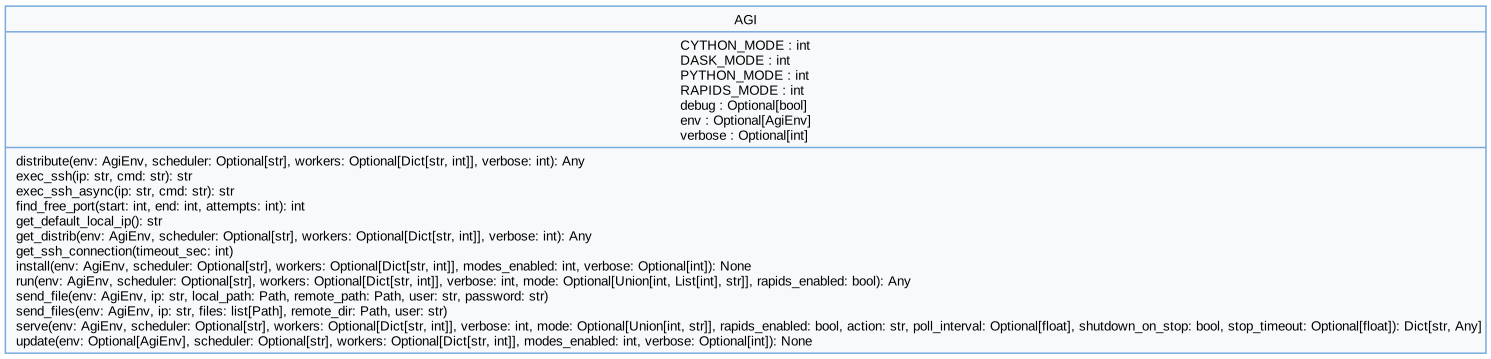
agi-distributor API
agi_distributor packages applications, ships the required artefacts to the
selected workers, and runs the chosen execution mode across the cluster.
Understanding modes_enabled and mode
The first thing to know before reading the examples is that AGILAB encodes execution toggles as a small bitmask.
Parameter |
Used by |
Meaning |
|---|---|---|
|
|
Bitmask of the execution capabilities that should be prepared during install. |
|
|
One concrete execution mode selected for the current run. |
The current bit values are:
Toggle |
Bit value |
Meaning |
|---|---|---|
|
|
Worker-pool path; backend may be process- or thread-based. |
|
|
Compiled worker path when available. |
|
|
Distributed Dask scheduler / remote worker path. |
|
|
RAPIDS / GPU path when supported. |
Prefer the public constants instead of typing numeric bitmasks:
AGI.PYTHON_MODE | AGI.DASK_MODEfor the Minimal App docs example.AGI.PYTHON_MODEfor the Flight docs example.
This is why the install examples below pass named constants through
modes_enabled=... and the run examples pass the same intent through a
RunRequest. Older snippets may contain raw integers, but public examples
should not teach those values directly.
In normal usage, these values are generated from the UI toggles rather than typed manually.
The literal-included Minimal App and Flight snippets below follow the same
conventions as the packaged examples under src/agilab/examples: they
resolve built-in apps from apps/builtin and keep Cython off for the public
first-run examples. The docs snippets stay Python-only for the first run,
while the packaged Flight install example also enables Dask. Cython
can still be enabled intentionally later, after the local Python/Dask path is
known-good.
Usage Example
Installation
Install the minimal_app example:
import asyncio
from pathlib import Path

from agi_cluster.agi_distributor import AGI
from agi_env import AgiEnv


APP = "minimal_app_project"
NO_CYTHON_RUN_MODES = AGI.PYTHON_MODE | AGI.DASK_MODE


def agilab_apps_path() -> Path:
    marker = Path.home() / ".local/share/agilab/.agilab-path"
    if not marker.is_file():
        raise SystemExit(
            "AGILAB is not initialized. Run the AGILAB installer or "
            "`agilab first-proof --json` before this example."
        )
    return Path(marker.read_text(encoding="utf-8").strip()) / "apps" / "builtin"


async def main():
    app_env = AgiEnv(apps_path=agilab_apps_path(), app=APP, verbose=1)
    res = await AGI.install(
        app_env,
        modes_enabled=NO_CYTHON_RUN_MODES,
        scheduler="127.0.0.1",
        workers={"127.0.0.1": 1},
    )
    print(res)
    return res


if __name__ == "__main__":
    asyncio.run(main())
Install the flight example:
import asyncio
from pathlib import Path

from agi_cluster.agi_distributor import AGI
from agi_env import AgiEnv


APP = "flight_telemetry_project"
PYTHON_ONLY_MODE = AGI.PYTHON_MODE


def agilab_apps_path() -> Path:
    marker = Path.home() / ".local/share/agilab/.agilab-path"
    if not marker.is_file():
        raise SystemExit(
            "AGILAB is not initialized. Run the AGILAB installer or "
            "`agilab first-proof --json` before this example."
        )
    return Path(marker.read_text(encoding="utf-8").strip()) / "apps" / "builtin"


async def main():
    app_env = AgiEnv(apps_path=agilab_apps_path(), app=APP, verbose=1)
    res = await AGI.install(
        app_env,
        modes_enabled=PYTHON_ONLY_MODE,
    )
    print(res)
    return res


if __name__ == "__main__":
    asyncio.run(main())
Distribute
Create the distribution bundle that will be sent to the workers:
import asyncio
from pathlib import Path

from agi_cluster.agi_distributor import AGI
from agi_env import AgiEnv


APP = "minimal_app_project"


def agilab_apps_path() -> Path:
    marker = Path.home() / ".local/share/agilab/.agilab-path"
    if not marker.is_file():
        raise SystemExit(
            "AGILAB is not initialized. Run the AGILAB installer or "
            "`agilab first-proof --json` before this example."
        )
    return Path(marker.read_text(encoding="utf-8").strip()) / "apps" / "builtin"


async def main():
    app_env = AgiEnv(apps_path=agilab_apps_path(), app=APP, verbose=1)
    res = await AGI.get_distrib(
        app_env,
        scheduler="127.0.0.1",
        workers={"127.0.0.1": 1},
        data_in="minimal_app/dataset",
        data_out="minimal_app/dataframe",
        files="*",
        nfile=1,
    )
    print(res)
    return res


if __name__ == "__main__":
    asyncio.run(main())
Equivalent example for flight:
import asyncio
from pathlib import Path

from agi_cluster.agi_distributor import AGI
from agi_env import AgiEnv


APP = "flight_telemetry_project"


def agilab_apps_path() -> Path:
    marker = Path.home() / ".local/share/agilab/.agilab-path"
    if not marker.is_file():
        raise SystemExit(
            "AGILAB is not initialized. Run the AGILAB installer or "
            "`agilab first-proof --json` before this example."
        )
    return Path(marker.read_text(encoding="utf-8").strip()) / "apps" / "builtin"


async def main():
    app_env = AgiEnv(apps_path=agilab_apps_path(), app=APP, verbose=1)
    res = await AGI.get_distrib(
        app_env,
        scheduler="127.0.0.1",
        workers={"127.0.0.1": 1},
        data_source="file",
        data_in="flight_telemetry/dataset",
        data_out="flight_telemetry/dataframe",
        files="*",
        nfile=1,
    )
    print(res)
    return res


if __name__ == "__main__":
    asyncio.run(main())
Run
Start with the simplest mental model first:
from agi_cluster.agi_distributor import AGI, RunRequest

request = RunRequest(mode=AGI.PYTHON_MODE)
res = await AGI.run(app_env, request=request)
Then move to the generated examples that add install-time capabilities, distributed hosts, and app-specific arguments:
import asyncio
from pathlib import Path

from agi_cluster.agi_distributor import AGI, RunRequest
from agi_env import AgiEnv


APP = "minimal_app_project"
NO_CYTHON_RUN_MODES = AGI.PYTHON_MODE | AGI.DASK_MODE


def agilab_apps_path() -> Path:
    marker = Path.home() / ".local/share/agilab/.agilab-path"
    if not marker.is_file():
        raise SystemExit(
            "AGILAB is not initialized. Run the AGILAB installer or "
            "`agilab first-proof --json` before this example."
        )
    return Path(marker.read_text(encoding="utf-8").strip()) / "apps" / "builtin"


async def main():
    app_env = AgiEnv(apps_path=agilab_apps_path(), app=APP, verbose=1)
    request = RunRequest(
        mode=NO_CYTHON_RUN_MODES,
        scheduler="127.0.0.1",
        workers={"127.0.0.1": 1},
    )
    res = await AGI.run(app_env, request=request)
    print(res)
    return res


if __name__ == "__main__":
    asyncio.run(main())
Equivalent example for flight:
import asyncio
from pathlib import Path

from agi_cluster.agi_distributor import AGI, RunRequest
from agi_env import AgiEnv


APP = "flight_telemetry_project"
PYTHON_ONLY_MODE = AGI.PYTHON_MODE


def agilab_apps_path() -> Path:
    marker = Path.home() / ".local/share/agilab/.agilab-path"
    if not marker.is_file():
        raise SystemExit(
            "AGILAB is not initialized. Run the AGILAB installer or "
            "`agilab first-proof --json` before this example."
        )
    return Path(marker.read_text(encoding="utf-8").strip()) / "apps" / "builtin"


async def main():
    app_env = AgiEnv(apps_path=agilab_apps_path(), app=APP, verbose=1)
    request = RunRequest(
        params={
            "data_source": "file",
            "files": "*",
            "nfile": 1,
            "nskip": 0,
            "nread": 0,
            "sampling_rate": 1.0,
            "datemin": "2020-01-01",
            "datemax": "2021-01-01",
            "output_format": "parquet",
        },
        data_in="flight_telemetry/dataset",
        data_out="flight_telemetry/dataframe",
        mode=PYTHON_ONLY_MODE,
    )
    res = await AGI.run(app_env, request=request)
    print(res)
    return res


if __name__ == "__main__":
    asyncio.run(main())
Reference

Cluster workplan utilities for distributing AGILab workloads.