agi-node API
Path handling
Workers do not resolve dataset or workspace paths themselves. Path
normalisation lives in agi_node.agi_dispatcher.base_worker_path_support and
is reached through private BaseWorker helpers (_normalized_path,
_share_root_path, _resolve_data_dir, _resolved_data_roots). There is
no public normalisation entry point: BaseWorker applies it for you from
setup_args, from_toml, and prepare_output_dir.
What that resolution guarantees:
Relative values are resolved against the share root, so configuration files can ship entries such as
<app>/datasetand still land on the correct worker share on every host.UNC-style shares on Windows (for example
\\server\share) keep their double backslashes.Symlinks and bind mounts created by installers are preserved, and directories that only appear later during the run are still accepted.
The conventional argument fields are data_in and data_out. data_uri
was the earlier name for data_in; it survives only as a legacy alias that
app argument models migrate on load — see
src/agilab/apps/builtin/minimal_app_project/src/minimal_app/app_args.py.
Do not introduce it in new code.
Note
Earlier revisions of this page described a public
BaseWorker.normalize_data_uri helper and a self.args.data_uri field.
Neither exists. Call setup_args and let it resolve paths for you.
Argument helpers
Recent updates to BaseWorker standardise how workers load, merge, and persist
their argument models. Every subclass can opt into the following hooks:
default_settings_pathanddefault_settings_sectioncontrol the TOML source used byfrom_toml/to_toml.args_loaderandargs_mergerare callables that fetch and combine raw settings with user overrides before instantiating the worker.args_ensure_defaultslets workers patch derived values (for example, normalising paths) after the merge but before instantiation.args_dumperandargs_dump_modedefine howto_tomlemits the active configuration, enabling round-trips back intoapp_settings.toml.
If these helpers live in the worker module (for example load_args or
dump_args defined alongside the class) or inside a sibling *_args/app_args
module, BaseWorker auto-binds them during class creation. That lets most apps
drop the explicit args_loader = … boilerplate while still allowing manual
overrides for custom integrations.
Managed PC path remapping
managed_pc_path_fieldslists argument attributes that should be remapped to the managed-machine workspace (~/MyAppby default) whenAgiEnvreports a managed PC.managed_pc_home_suffixcustomises the managed workspace folder name if your deployment uses something other thanMyApp.BaseWorker.from_tomlapplies the remapping automatically; when instantiating a worker manually, usesetup_argsto apply defaults and remap paths in a single call.setup_argsoptionally acceptsoutput_field(e.g."data_uri") along withoutput_subdir,output_attr,output_cleanandoutput_parents_upso managers can prepare their output directories without repeating boilerplate.
Output directory helpers
prepare_output_dircentralises the setup of manager-side output folders (subdirectorydataframeby default). Hand it the base path you want to target and it resolves the path through the share resolver, clears old contents whencleanis true (the default, and whatsetup_argspasses asoutput_clean), creates the directory, and stores it onself.data_outunless you overrideattribute.It is also a validation boundary: it raises
ValueErrorfor a drive-relative root, for..traversal in either the root or the subdirectory, and for a subdirectory that is absolute. Catch it if your manager accepts an operator-supplied output path.
With these attributes in place, BaseWorker.from_toml produces a configured
instance and BaseWorker.to_toml writes the updated schema without each app
copying boilerplate. BaseWorker.as_dict exposes a serialisable payload for
Web pages and API consumers, while _extend_payload stays available for
apps that need to enrich the exported structure.
Reference
This page documents the public worker foundation and the concrete worker types.
Operational build and hook entry points such as build, pre_install, and
post_install remain covered in the runbook because they are packaging
tooling rather than the main API surface extended by app authors.
base_worker

node module
Auteur: Jean-Pierre Morard
- class agi_node.agi_dispatcher.base_worker.ArgsNamespace(mapping_or_iterable=(), /, **kwargs)[source]
Bases:
SimpleNamespaceNamespace that supports both attribute and key-style access.
- class agi_node.agi_dispatcher.base_worker.BaseWorker[source]
Bases:
ArtifactContract,ABCclass BaseWorker v1.0
- args_dump_mode = 'json'
- args_dumper = None
- args_ensure_defaults = None
- args_loader = None
- args_merger = None
- break()
Signal the service loop to exit on this worker.
- Return type:
bool
- default_settings_path = 'app_settings.toml'
- default_settings_section = 'args'
- distribution_cache_inputs()[source]
Return additional filesystem inputs that determine the work plan.
WorkDispatcherautomatically fingerprints conventional argument fields such asdata_inandsubmission_inbox. Applications whose planner reads other filesystem locations can expose those roots here without changing the stablebuild_distribution(workers)signature. Setdistribution_cache_inputs_modeto"replace"when these declared paths are the complete planner input set.- Return type:
Iterable[Path|str]
- distribution_cache_inputs_mode = 'augment'
- env = None
- static expand(path, base_directory=None)[source]
Expand a given path to an absolute path. :param path: The path to expand. :type path: str :param base_directory: The base directory to use for expanding the path. Defaults to None. :type base_directory: str, optional
- Returns:
The expanded absolute path.
- Return type:
str
- Raises:
None –
Note
This method handles both Unix and Windows paths and expands ‘~’ notation to the user’s home directory.
- static expand_and_join(path1, path2)[source]
Join two paths after expanding the first path.
- Parameters:
path1 (str) – The first path to expand and join.
path2 (str) – The second path to join with the expanded first path.
- Returns:
The joined path.
- Return type:
str
- static loop(*, poll_interval=None)[source]
Run a long-lived service loop on this worker until signalled to stop.
The derived worker can implement a
loopmethod accepting either zero arguments or a singlestop_eventargument. When the method signature acceptsstop_event(keywordstop_eventorshould_stop), the worker implementation is responsible for honouring the event. Otherwise the base implementation repeatedly invokes the method and sleeps for the configured poll interval between calls. ReturningFalsefrom the worker method requests termination of the loop.- Return type:
Dict[str,Any]
- managed_pc_home_suffix = 'MyApp'
- managed_pc_path_fields = ()
- static normalize_dataset_path(data_path)[source]
Normalise any dataset directory input so workers rely on consistent paths.
- Return type:
str
- pool_init(worker_vars)[source]
Per-pool-child initializer hook; default is a no-op.
- Return type:
None
- pool_vars = None
Shared state handed to
pool_initin every pool child. Apps usually setself.pool_vars = {"args": self.args}instart(). For process-based worker families (pandas/fireducks) the worker instance andpool_varsmust be picklable.
- prepare_output_dir(root, *, subdir='dataframe', attribute='data_out', clean=True)[source]
Create (and optionally reset) a deterministic output directory.
- Return type:
Path
- classmethod resolve_generated_artifact_path(data_in_root, data_out_root, artifact_path)[source]
- Return type:
Path
- classmethod resolve_input_folder(env, dataset_root, relative_dir, *, descriptor, fallback_subdirs=(), dataset_namespace=None, min_files=1, patterns=None, required_label='data files')[source]
- Return type:
Path
- setup_args(args, *, env=None, error=None, output_field=None, output_subdir='dataframe', output_attr='data_out', output_clean=True, output_parents_up=0)[source]
- Return type:
Any
- setup_data_directories(*, source_path, target_path=None, target_subdir='dataframe', reset_target=False)[source]
Prepare normalised input/output dataset paths without relying on worker args.
Returns a namespace with the resolved input path (input_path), the normalised string used by downstream readers (normalized_input), the output directory as a
Path(output_path), and its normalised string representation (normalized_output). Optionally clears and recreates the output directory.- Return type:
SimpleNamespace
- verbose = 1
dag_worker
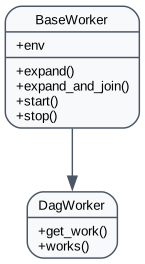
- class agi_node.dag_worker.dag_worker.DagWorker[source]
Bases:
BaseWorker- Minimal-change DAG worker:
Keeps your existing structure
Adds a tiny signature-aware _invoke() so custom methods can vary in signature
Uses _invoke() at the single call site in ._exec_multi_process()
- works(workers_plan, workers_plan_metadata)[source]
Execute the DAG plan and return this call’s elapsed seconds.
DagWorker intentionally ignores the pool/dask mode bits: stages are always scheduled on the in-worker thread pool because dependency ordering (not the ORCHESTRATE pool toggle) drives concurrency here.
- Return type:
float
pandas_worker
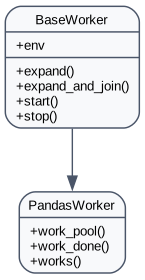
pandas_worker Framework Callback Functions Module
This module provides the PandasWorker class, which extends the foundational functionalities of BaseWorker for processing data using multiprocessing or single-threaded approaches with pandas.
- Classes:
PandasWorker: Worker class for data processing tasks using pandas.
- Internal Libraries:
os
- External Libraries:
concurrent.futures.ProcessPoolExecutor pathlib.Path pandas as pd BaseWorker from node import BaseWorker.node
- class agi_node.pandas_worker.pandas_worker.PandasWorker[source]
Bases:
BaseWorkerPandasWorker Class
Inherits from
BaseWorkerto provide extended data processing functionalities using pandas.- verbose
Verbosity level for logging.
- Type:
int
- data_out
Path to the output directory.
- Type:
str
- worker_id
Identifier for the worker instance.
- Type:
int
- args
Configuration arguments for the worker.
- Type:
dict
- work_done(df=None)[source]
Handles the post-processing of the DataFrame after work_pool execution.
- Parameters:
df (
DataFrame) – The pandas DataFrame to process. Defaults to None.- Raises:
ValueError – If an unsupported output format is specified.
- Return type:
None
- work_pool(x=None)[source]
Processes a single task.
- Parameters:
x (
any) – The task to process. Defaults to None.- Returns:
A pandas DataFrame with the processed results.
- Return type:
DataFrame
- works(workers_plan, workers_plan_metadata)[source]
Executes worker tasks based on the distribution tree.
- Parameters:
workers_plan (
any) – Distribution tree structure.workers_plan_metadata (
any) – Additional information about the workers.
- Returns:
Execution time of this works() call in seconds.
- Return type:
float
polars_worker
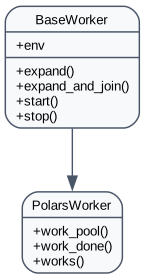
data_worker Framework Callback Functions Module
This module provides the PolarsWorker class, which extends the foundational functionalities of BaseWorker for processing data using a thread pool or single-threaded approaches. The pool path deliberately uses threads rather than processes: polars releases the GIL in its native kernels, so threads parallelise IO/native work without process spawn and pickling costs.
- Classes:
PolarsWorker: Worker class for data processing tasks.
- External Libraries:
concurrent.futures.ThreadPoolExecutor pathlib.Path polars as pl BaseWorker from node import BaseWorker
- class agi_node.polars_worker.polars_worker.PolarsWorker[source]
Bases:
BaseWorkerPolarsWorker Class
Inherits from
BaseWorkerto provide extended data processing functionalities.- verbose
Verbosity level for logging.
- Type:
int
- data_out
Path to the output directory.
- Type:
str
- worker_id
Identifier for the worker instance.
- Type:
int
- args
Configuration arguments for the worker.
- Type:
dict
- work_done(df=None)[source]
Handles the post-processing of the DataFrame after work_pool execution.
- Parameters:
df (
DataFrame) – The Polars DataFrame to process. Defaults to None.- Raises:
ValueError – If an unsupported output format is specified.
- Return type:
None
- work_pool(x=None)[source]
Processes a single task.
- Parameters:
x (
any) – The task to process. Defaults to None.- Returns:
A Polars DataFrame with the processed results.
- Return type:
DataFrame
- works(workers_plan, workers_plan_metadata)[source]
Executes worker tasks based on the distribution tree.
- Parameters:
workers_plan (
any) – Distribution tree structure.workers_plan_metadata (
any) – Additional information about the workers.
- Returns:
Execution time of this works() call in seconds.
- Return type:
float