Solvers
Solvers
Near production numerical solver flow.
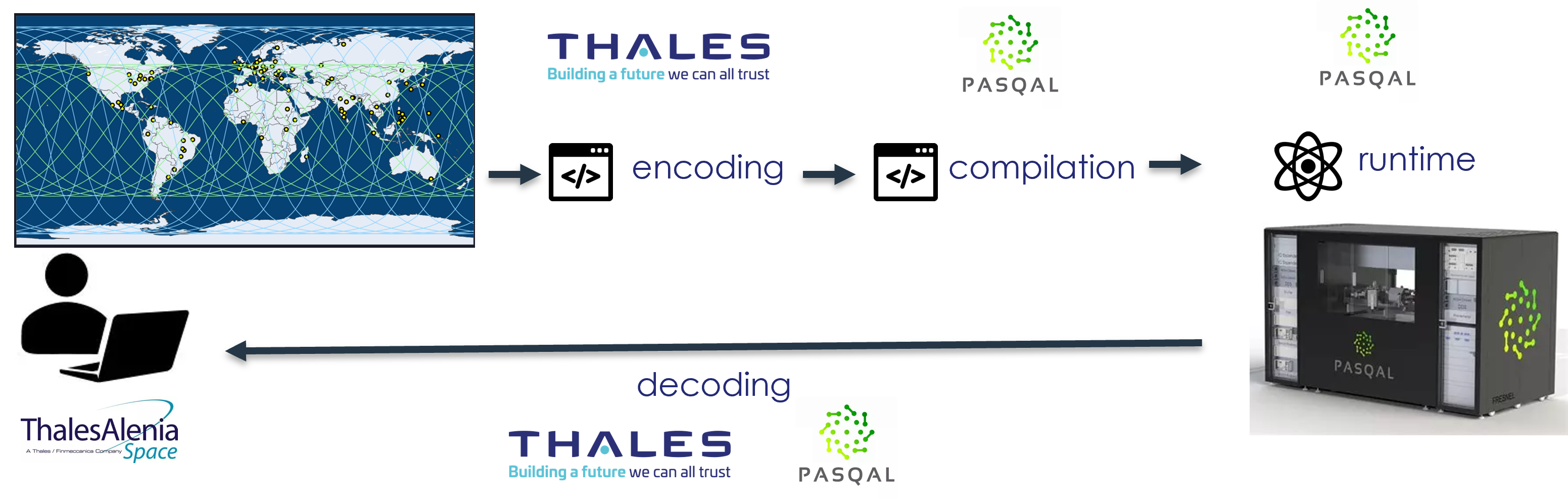
From requests to Maximum Independent Set
From previous discretization in time of satellites data take opportunities, we end up with DTOS and PRIORITIES. We now need too feed this data to our solvers.
from spot.mis.solver import Solver
solver = Solver()
First, we need to collect opportunities from DTOs of each satelllite.
collected_opportunities = solver.collect_opportunities(dtos, priorities)This array is then converted to a graph with edges constraining missions to respect operational constraints.
solving_graph = solving_map.graph_from_collected_opportunities(collected_opportunities)These graphs can be fed to Maximum Independent Set solver
Networkx solver
We will need a classical solver to benchmark our computations on real hardware. We here describe the algorithm taken as state of the art resolution method to cover the MIS problemm.
classical_solver = NetworkxSolver()
mis_nodes = classical_solver.get_maximum_independet_set(solving_graph)
This returns and list of nodes which should be independent.
Rydberg solver
We can use already described PASQAL solution
from spot.mis.rydbgerg.qubo import SpotQuboSolver

quantum_solver = SpotQUBOSolver()
mis_nodes = quantum_solver.get_maximum_independet_set(solving_graph)
Or use a standalone autoencoder-driver solution (less reliable)
quantum_solver = PulseSolver()
mis_nodes  = quantum_solver.get_maximum_independet_set(solving_graph)
Recover global plan
Finally, independently of the quantum algorithm chosen, we can recover the global plan and compute metrics.
global_plan = solver.get_global_plan(mis_nodes)Go to the next page (numerical experiments) to know more about how to interprete the results.