Leaderboard
The PASSAGE leaderboard compares complete planning procedures on the same tasks and the same hardware. Each entry is a frozen candidate package that Thales runs on the complete test split, on each edge target, under one evaluation contract. The emitted routes are then scored independently on a separate host. Anyone can propose a candidate: Submit a candidate explains the process, and Official evaluation lists what Thales does to turn a submission into an official result.
What every entry is measured on
All entries share one task profile, so their numbers can be compared target by target.
Table 1. The leaderboard task profile.
| Item | Value |
|---|---|
| Data | PASSAGE v1.0, revision c09cc5a21a55a93e7c09d47368d5f5bf75cb8fae |
| Task | 256 × 256 scenes, elevation objective with weight 62.4, eight-connected grid of 30 m cells, obstacles blocked |
| Population | The complete test split: 40,000 scenes from the South-American geographic hold-out |
| Request | One ordinary input per scene (elevation, obstacles, start, goal); reference routes and costs stay on the host |
| Deadline | 5 s per request; a later legal route counts as a timeout failure |
| Training seeds | Three independently trained checkpoints, seeds 1234, 2026 and 3407 (none for a classical planner) |
| Targets | NVIDIA Jetson AGX Orin, NVIDIA Jetson AGX Thor, Intel Tiger Lake (Core i7-1185GRE with Iris Xe graphics) |
| Timing | Batch one, one persistent session per target and seed, 16 warm-up calls on a separate validation scene; the timer runs from raw in-memory arrays to the returned route |
| Scores | Median and p90 cost regret, ASSD, H95, success rate and obstacle-violation rate, with p50, p95 and p99 latency |
| Reference | An exact CPU A* session on each target, shown beside the candidates and outside their ranking |
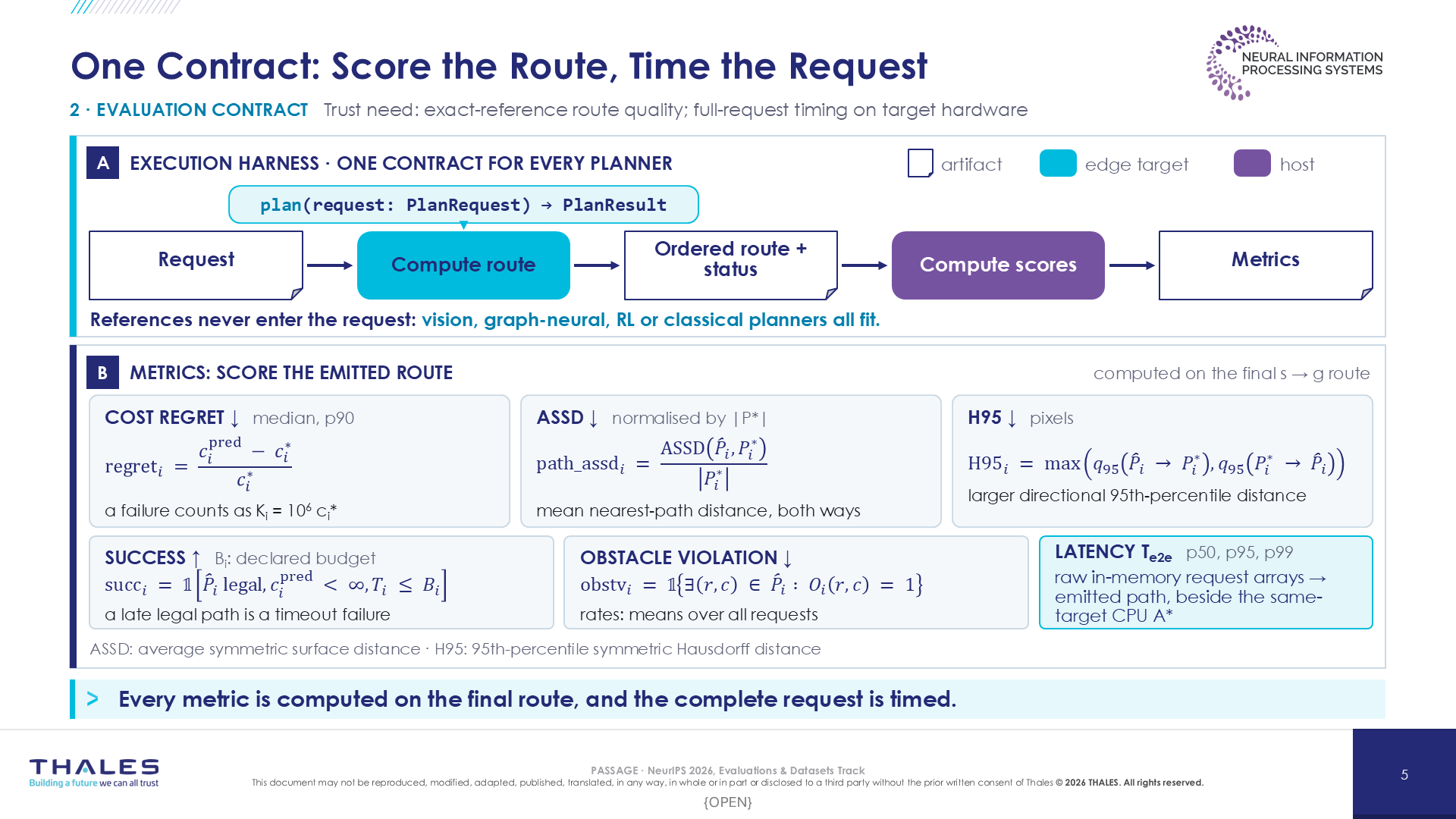
Figure 1. The evaluation contract, as presented in the NeurIPS 2026 talk.
The evaluation protocol defines each metric, the failure penalty and the aggregation. Compare latency within a target: CPU, GPU and integrated-GPU execution differ between devices.
Main candidates
The leaderboard opens with two candidates contributed by the PASSAGE authors. Both bridge vision networks and path planning: a dense network predicts a field over the grid, then a frozen graph decoder turns that field into a legal route.
Table 2. The main candidates and the reference.
| Entry | Idea | Model page |
|---|---|---|
| Seg — segmentation | ConvNeXt V2 Atto predicts where the route passes; a raw-logit A* connects start and goal | thalesgroup/passage-seg-convnextv2-atto |
| Reg — regression | RepViT M1 predicts the remaining cost to the goal; a Bellman descent follows it, with a Dijkstra reconnection if it stalls | thalesgroup/passage-reg-repvit-m1 |
| A* — reference | Exact search on the physical edge costs, on the target CPU | Part of the evaluator |
Each model page documents its method, training, exports and how to run it; the repositories currently require authorised Hugging Face access. Both candidates were measured with their three seeds on the three targets, over the complete test split. The paper results report the original study, whose sessions differ from the leaderboard rows on Tiger Lake in particular.
How the main candidates were integrated
Seg and Reg follow the structure that a new candidate uses. Their model repositories are therefore complete worked examples.
What each model repository contains.
- An adapter class,
candidate_adapter:Candidate, exposingplan(PlanRequest) → PlanResultfor the common worker. - The ONNX exports of the network for the three seeds, and the decoder source.
- Hashed dependency locks and a container recipe that installs the public core.
- Licence, third-party notices and a model card describing the method, the training data and any prior use of the test split.
- A descriptor,
candidate.source.json, listing these files with their hashes.passage-eval candidate freezeseals it into apassage-candidate-package/v1manifest. Any change to code, weights, locks, recipe or budget makes a new version.
How Thales measured them.
- For each edge target, Thales compiled the network exports for the target runtime: TensorRT on the two Jetson devices and OpenVINO on Tiger Lake. The decoder ran on the target CPU.
- A functional check ran each export on each native target, on one validation scene.
- Each seed then ran on each target in a persistent session over the 40,000 test scenes, beside one CPU A* session per target.
- A separate host scored every returned route against the stored references. Each target and seed became one row, with its evidence identities attached.
Entry status
Every row carries one status:
- Measured: Thales ran the identified package and scored its routes on the host. The evidence is retained, but it has not been reviewed for admission.
- Verified: Thales also reviewed the evidence of that exact package and signed its admission for this task profile.
All current rows, including Seg and Reg, are measured. No row is verified yet: the signing policy and operator key that verification requires are still to be put in place (see Official evaluation). A local score computed by a contestant is not a leaderboard entry. Neither are the paper results, which report the original study.
Enter the leaderboard
- Build your candidate as a package, on the model of Seg and Reg.
- Check it locally with the same public tools Thales uses.
- Open a submission request.
Submit a candidate gives each step and its checklist.